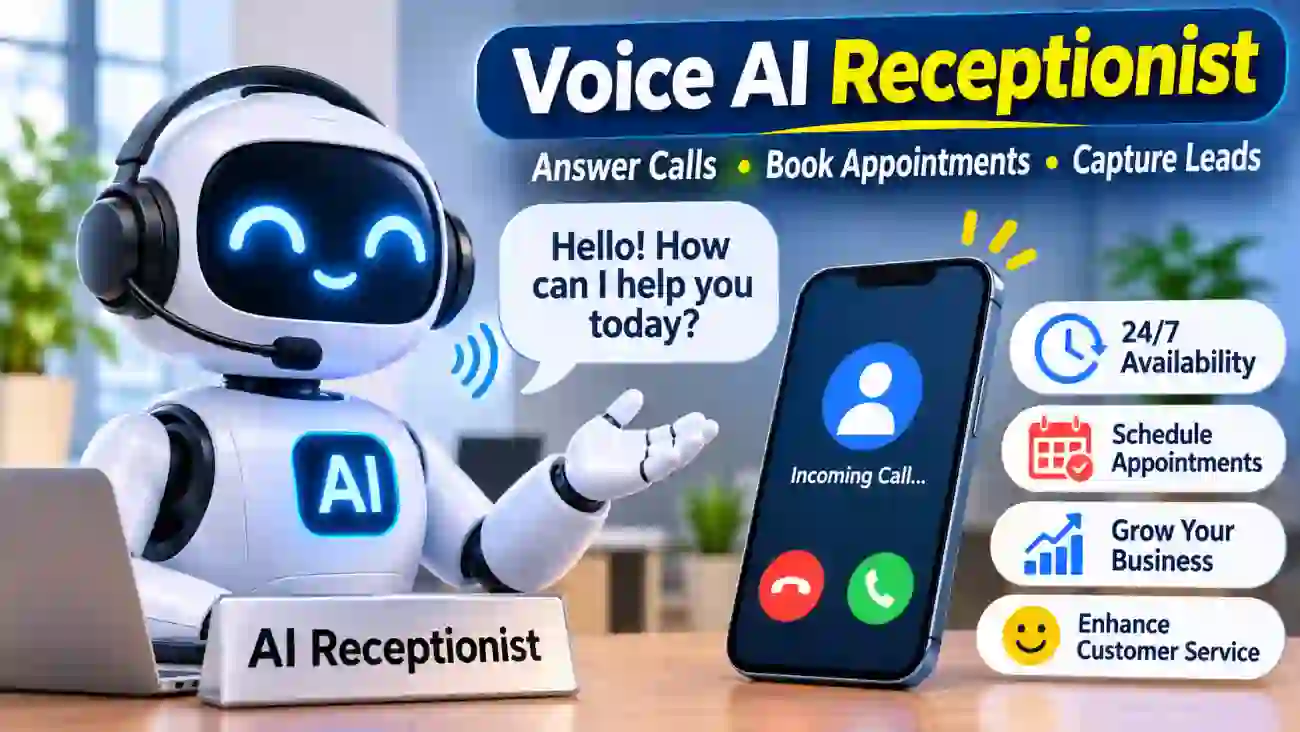
A voice AI receptionist is an automated phone assistant that uses artificial intelligence to answer business calls, talk with customers, schedule appointments, and handle common questions. It works around the clock, helping businesses manage incoming calls, reduce missed opportunities, and provide faster customer support without hiring additional reception staff.
Key Takeaways
- A voice AI receptionist answers incoming business calls using natural-sounding conversations.
- It can schedule appointments, answer questions, collect customer details, and route calls.
- Small businesses use it to reduce missed calls and improve customer service.
- AI receptionists can operate 24/7 without traditional staffing requirements.
- Choosing the right system depends on features, pricing, integrations, and business needs.
voice ai receptionist
Introduction
Every missed business call can mean a lost customer, missed appointment, or forgotten sales opportunity. However, many small businesses cannot afford to keep someone available to answer the phone throughout the day.
A voice AI receptionist offers another way to manage incoming calls. It uses artificial intelligence to speak with callers, understand their questions, provide helpful answers, and complete basic tasks without requiring a human receptionist.
This technology is becoming useful for businesses that want faster customer support and better phone coverage. From home service companies to medical offices and real estate agencies, organizations can use AI-powered phone assistants to handle everyday conversations.
In this guide, you’ll learn what a voice AI receptionist does, why businesses use one, which features matter most, and how to choose a solution that fits your needs.
What Does “Voice AI Receptionist” Mean?
A voice AI receptionist is an intelligent phone assistant that answers and manages business calls using artificial intelligence.
Unlike a traditional automated phone menu, it can understand spoken questions and respond naturally. Callers can explain what they need instead of pressing several buttons to reach the right department.
The technology often combines speech recognition, natural language processing, and text-to-speech tools. These technologies help the system understand callers and respond with human-like speech.
Businesses commonly use voice AI receptionists for:
- Answering incoming customer calls.
- Scheduling and confirming appointments.
- Sharing business hours and service information.
- Collecting customer contact details.
- Transferring calls to the right employee.
- Handling frequently asked questions.
- Taking messages when staff members are unavailable.
The main goal is to make phone communication easier while allowing employees to focus on other important tasks.
Why Use a Voice AI Receptionist?
Traditional reception services can be expensive, especially for small businesses with limited budgets. Employees may also miss calls when they are busy helping customers, attending meetings, or completing other work.
An AI-powered receptionist helps solve these problems by providing consistent phone coverage.
Here are some important benefits:
- Reduce missed calls: Answer incoming calls even when employees are busy.
- Improve customer experience: Give callers quick answers without unnecessary waiting.
- Save time: Automate repetitive conversations and routine phone tasks.
- Provide after-hours support: Handle calls outside normal business hours.
- Capture more leads: Collect information from potential customers before they hang up.
- Support business growth: Manage higher call volumes without immediately expanding reception staff.
However, AI should not replace human support in every situation. Complicated complaints, sensitive conversations, and unusual requests may still require an experienced employee.
10 Best Features to Look for in a Voice AI Receptionist
Choosing a voice AI receptionist involves more than finding software that can answer calls. The best solution should support your daily operations and provide a smooth experience for customers.
Here are 10 important features to consider.
1. Natural-Sounding Voice Conversations
A good AI receptionist should communicate clearly and naturally. Callers should feel comfortable speaking with the system instead of listening to robotic responses.
Best For: Customer service, professional businesses, and companies handling frequent inbound calls.
Example: A customer calls a repair company and explains that their air conditioner stopped working. The AI understands the request and asks relevant follow-up questions.
Example: Someone contacts a dental office to ask about available cleaning appointments. The receptionist responds conversationally and guides them through the booking process.
Quick Tip: Test different voice options before choosing a provider. Clear speech and natural conversation matter more than fancy voice effects.
2. 24/7 Call Answering
This feature allows businesses to answer calls outside regular working hours. Customers can receive basic assistance even when the office is closed.
Best For: Small businesses, home service companies, and businesses serving customers across different time zones.
Example: A homeowner calls a plumbing company at 9 p.m. to report a leaking pipe.
Example: A potential customer contacts a cleaning service early Sunday morning to request a quote.
Quick Tip: Set clear after-hours rules so callers know which services are available and when a human employee will respond.
3. Appointment Scheduling
An AI receptionist can connect with supported scheduling systems to check available time slots and book appointments.
This reduces manual booking work and helps customers arrange services without waiting for office staff.
Best For: Medical offices, salons, dental clinics, and consulting businesses.
Example: A patient calls a clinic and books an available appointment for Thursday afternoon.
Example: A customer contacts a beauty salon and selects an available haircut appointment.
Quick Tip: Make sure the software checks real-time calendar availability to prevent double bookings.
4. Intelligent Call Routing
Call routing helps direct customers to the correct department or employee based on their requests.
Instead of navigating a complicated phone menu, callers can explain their needs in everyday language.
Best For: Growing companies, property management businesses, and organizations with multiple departments.
Example: A customer asking about billing gets connected to the accounts team.
Example: A new sales lead is transferred directly to the appropriate sales representative.
Quick Tip: Create simple routing rules and provide a backup contact when the intended employee is unavailable.
5. Customer Information Collection
A voice AI receptionist can collect useful details during phone conversations. These may include customer names, phone numbers, service requirements, and preferred appointment times.
Best For: Contractors, insurance agencies, real estate businesses, and service providers.
Example: A roofing company collects a homeowner’s address and details about a damaged roof.
Example: A real estate office records a buyer’s preferred neighborhood and property budget.
Quick Tip: Only collect information your business actually needs, and protect customer data appropriately.
6. CRM Integration
CRM integration allows the receptionist to exchange information with customer relationship management software.
It can help update customer records, save lead details, and keep communication organized.
Best For: Sales teams, marketing agencies, and businesses managing large customer databases.
Example: A new caller’s contact details are added to the company’s CRM after the conversation.
Example: An existing customer calls about a previous service request, and the system retrieves available customer information.
Quick Tip: Check whether your preferred CRM is supported before purchasing a subscription.
7. Automated Lead Qualification
Some AI receptionists can ask questions to understand whether a caller is a potential customer.
This helps businesses identify valuable inquiries and prioritize follow-ups.
Best For: Real estate agencies, marketing companies, home improvement businesses, and B2B service providers.
Example: A remodeling company learns whether a caller needs kitchen renovation, bathroom renovation, or general repairs.
Example: A marketing agency collects information about a prospect’s business size and advertising goals.
Quick Tip: Keep qualification questions short and relevant to avoid frustrating callers.
8. Call Transcription and Summaries
Call transcription converts spoken conversations into written records. Some systems also create short summaries that explain the caller’s needs and any next steps.
Best For: Customer support teams, appointment-based businesses, and companies managing frequent inquiries.
Example: A support manager reviews a written summary of a customer’s complaint before returning the call.
Example: A contractor checks a call transcript to confirm the customer’s requested repair service.
Quick Tip: Review recording, consent, and data-retention settings to ensure your business follows applicable privacy requirements.
9. Custom Business Knowledge
A useful AI receptionist should understand your company’s services, policies, opening hours, and frequently asked questions.
This allows it to provide answers that match your actual business information.
Best For: Retail stores, professional service providers, healthcare offices, and local businesses.
Example: A caller asks whether a repair company offers weekend appointments.
Example: A customer contacts a retail business to ask about its return policy.
Quick Tip: Update the system whenever your prices, services, business hours, or policies change.
10. Human Call Transfer
Even advanced AI systems cannot handle every conversation. Human call transfer allows the receptionist to connect callers with an employee when additional help is necessary.
Best For: Businesses with complex customer requests, technical support needs, or sensitive conversations.
Example: A frustrated customer asks to speak with a manager about an unresolved issue.
Example: A caller with a complicated insurance question is transferred to a qualified representative.
Quick Tip: Establish clear escalation rules so important calls never get stuck in an automated conversation.
Voice AI Receptionist Feature Comparison
| Feature | Best Used In | Main Benefit |
|---|---|---|
| Natural voice conversations | Customer service | Better communication |
| 24/7 call answering | Small businesses | Constant availability |
| Appointment scheduling | Clinics and salons | Easier bookings |
| Intelligent call routing | Growing companies | Faster connections |
| Customer information collection | Service providers | Organized leads |
| CRM integration | Sales teams | Better records |
| Lead qualification | Real estate and agencies | Better lead management |
| Call transcription | Support teams | Written call records |
| Custom business knowledge | Local businesses | Accurate answers |
| Human call transfer | Complex support | Personal assistance |
Common Mistakes When Choosing a Voice AI Receptionist
Buying AI receptionist software without understanding its limitations can create unnecessary problems.
Avoid these five common mistakes:
1. Choosing based on price alone: A cheap system may lack important features such as appointment scheduling, integrations, or call transfers. Compare the overall value instead of focusing only on subscription costs.
2. Ignoring conversation quality: Poor voice quality and confusing responses can frustrate callers. Test real conversations before committing to a provider.
3. Not checking integrations: Your receptionist should work with the tools your business already uses. Otherwise, employees may need to enter the same information manually.
4. Expecting AI to handle everything: Some calls require human judgment, empathy, or professional expertise. Always provide a clear path to human assistance.
5. Forgetting privacy and security: Customer conversations may contain personal information. Review data protection practices, recording settings, access controls, and applicable legal requirements.
Frequently Asked Questions
1. What is a voice AI receptionist?
A voice AI receptionist is an automated phone assistant that uses artificial intelligence to communicate with callers. It can answer questions, schedule appointments, collect customer details, and transfer calls. Businesses use it to manage phone communication without requiring a human employee to answer every incoming call.
2. How does an AI voice receptionist work?
An AI voice receptionist uses speech recognition to understand what callers say. Natural language processing helps interpret their requests, while text-to-speech technology generates spoken responses. Depending on its features and integrations, the system can also schedule appointments, retrieve business information, and connect callers with employees.
3. Can a voice AI receptionist answer calls 24/7?
Yes. Many voice AI receptionist services can answer calls throughout the day and night. This allows businesses to provide basic customer support outside regular working hours. However, certain actions may depend on connected systems, business rules, subscription limits, and whether human employees are available for escalations.
4. Is a voice AI receptionist suitable for small businesses?
Yes. Small businesses can use AI receptionists to manage incoming calls without hiring additional full-time reception staff. Contractors, salons, dental offices, and local service providers can benefit from automated answering, appointment scheduling, and lead collection. The best choice depends on call volume and business requirements.
5. Can an AI receptionist schedule appointments?
Yes. Many AI receptionist platforms support appointment scheduling through calendar or booking software integrations. Customers can ask about available times and book appointments through phone conversations. Before choosing a service, confirm that it supports your scheduling platform and checks availability before confirming bookings.
6. Does a voice AI receptionist sound like a real person?
Modern systems can produce natural-sounding speech and respond conversationally. However, the experience varies between providers. Some offer realistic voices and flexible conversations, while others sound more automated. Testing the system with real customer questions is the best way to evaluate its communication quality.
7. How much does a voice AI receptionist cost?
Pricing depends on the provider, monthly call volume, features, integrations, and usage limits. Some services charge a monthly subscription, while others use per-minute or usage-based pricing. Businesses should also check setup fees, additional phone numbers, overage charges, and premium integration costs before choosing a plan.
8. Can an AI receptionist transfer calls to a human employee?
Yes. Many systems support human call transfers when callers need additional assistance. Businesses can create rules for sending calls to specific employees, departments, or backup numbers. This feature is especially important for complaints, complicated questions, urgent requests, and situations that require personal attention.
Conclusion
A voice AI receptionist can help businesses manage incoming calls, answer common questions, schedule appointments, and capture new leads. It provides an effective way to improve phone coverage without depending entirely on traditional reception staff.
However, the right solution depends on your company’s needs. Small businesses may prioritize affordable pricing and 24/7 answering, while larger organizations may need CRM integrations, intelligent call routing, and advanced reporting.
Before selecting a provider, test its voice quality, review its features, and check how well it connects with your existing business tools. Also, make sure customers can reach a real person when necessary.