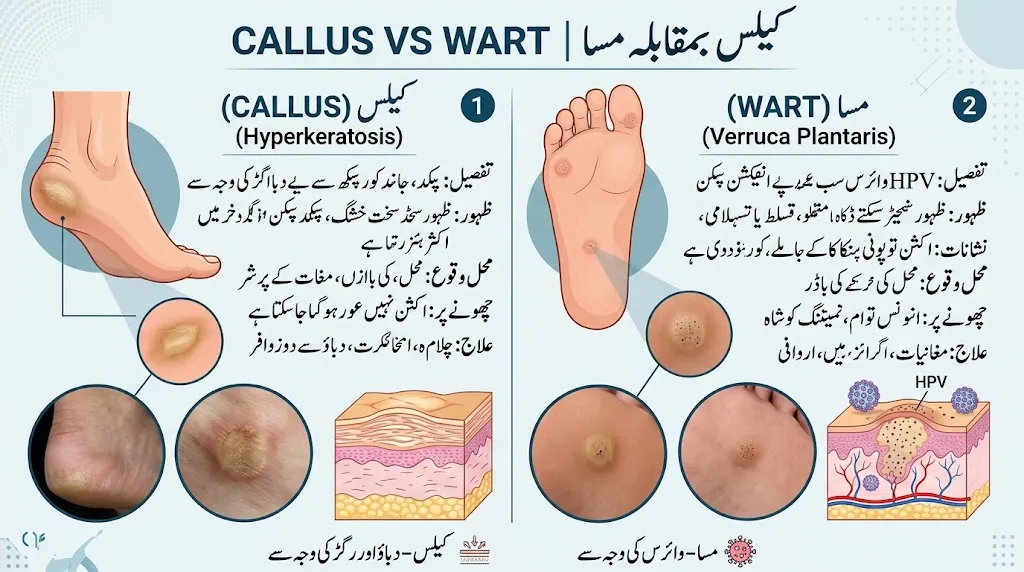
The main difference between a callus vs wart is the cause. A callus develops when repeated friction or pressure makes the skin thicker and harder.
A plantar wart is caused by certain types of human papillomavirus (HPV). Warts may have tiny black dots, interrupt normal skin lines, and can be painful when squeezed from the sides.
Key Takeaways
- Calluses are thickened skin caused mainly by repeated pressure or friction.
- Plantar warts are viral skin growths caused by HPV.
- Tiny black dots can occur in plantar warts because of small blood vessels.
- A callus generally keeps the normal lines of the skin, while a wart may interrupt them.
- If you are unsure what a growth is, especially if it hurts, bleeds, changes, or does not improve, a healthcare professional can help identify it.
What Is a Callus?
A callus is an area of thick, hardened skin that develops as the body responds to repeated friction or pressure. It is especially common on the feet and hands, where rubbing or pressure happens regularly.
For example, a callus may develop on the ball of your foot from repeated pressure while walking, or on your hand from playing an instrument or using a tool. Tight or poorly fitting footwear can also create the friction that leads to calluses.
Calluses are usually broader and flatter than corns. They can feel rough, dry, waxy, or hardened, and many are not particularly painful.
Common Causes of Calluses
Common causes include:
- Repeated friction from shoes
- Pressure while walking or standing
- Repetitive hand activities
- Poorly fitting footwear
- Repeated contact with tools or equipment
- Certain walking patterns that place extra pressure on one area
The key point is that a callus is a pressure-and-friction response, not a viral infection.
Where Calluses Usually Appear
Calluses commonly occur on:
- The soles of the feet
- Heels
- Balls of the feet
- Palms
- Fingers
- Other areas exposed to repeated rubbing
Their location often corresponds to an area experiencing regular pressure or friction.
What Is a Wart?
A wart is a skin growth caused by infection with certain types of HPV. Warts can appear on different parts of the body, including the hands and feet. When a wart develops on the sole of the foot, it is called a plantar wart.
Plantar warts can be confusing because walking puts pressure on them. That pressure can push the wart inward and cause hard skin to develop over it, making the growth look similar to a callus.
What Causes Plantar Warts?
Plantar warts develop when HPV enters through tiny cuts or breaks in the skin. Unlike a callus, a wart is therefore associated with a viral infection.
Warts can also occur in clusters. The American Academy of Dermatology describes these clusters as mosaic warts, which can cover a larger area of the sole.
Where Plantar Warts Appear
Plantar warts are most often found on the bottoms of the feet, including areas such as the ball of the foot and heel. They may be flat or pushed inward because of pressure from standing and walking.
Callus vs Wart: Key Differences
The easiest way to understand the callus vs wart difference is to compare their cause, appearance, skin pattern, and behavior.
| Feature | Callus | Plantar Wart |
| Main cause | Friction or pressure | HPV infection |
| Texture | Thick, hard, rough skin | Rough or grainy growth |
| Black dots | Usually absent | May be present |
| Skin lines | Usually continue through the area | Often interrupted |
| Typical location | Pressure/friction areas | Sole of the foot |
| Pain | Often little or no pain | May hurt, especially on pressure |
| Contagious | No | Yes, because it is viral |
| May occur in clusters | Not typical | Possible |
These features are useful clues, but no single sign proves what a skin growth is. Plantar warts can develop a layer of callused skin over them, which makes visual identification more difficult.
Appearance and Texture
A callus generally looks like a wider patch of thickened skin. It may blend gradually into the surrounding skin.
A plantar wart may appear more like a distinct rough growth. Because the sole of the foot is constantly under pressure, however, the wart may become flattened and surrounded by hardened skin.
That is one reason people frequently mistake a plantar wart for a callus.
Black Dots
One of the most discussed clues is the presence of tiny black dots.
Plantar warts can contain small black or dark pinpoint areas. These represent tiny blood vessels that may become visible within the wart.
A typical callus does not have these wart-associated pinpoint blood vessels.
Still, the absence of black dots does not automatically mean you have a callus. A thick layer of skin can hide features, and not every wart looks identical.
Skin Lines
Look at the natural lines and ridges around the affected area.
With a callus, normal skin markings generally continue across the thickened area. With a plantar wart, those lines may become interrupted or distorted by the growth.
This can be a useful clue, but it is not a substitute for professional diagnosis when the appearance is uncertain.
Pain and Pressure
The way a lesion responds to pressure can also provide a clue.
Calluses tend to be more uncomfortable when pressure is applied directly to the thickened area. Plantar warts can be particularly tender when pressure is applied from the sides.
Plantar warts may also hurt while walking because pressure from each step pushes the growth inward.
Pain alone, however, cannot reliably identify the lesion.
Location and Spread
A callus usually develops where repeated friction or pressure occurs. Its location often makes sense based on footwear, walking, work, sports, or another repetitive activity.
A plantar wart can also appear on a pressure-bearing area, but it is not simply a response to pressure. It results from HPV infection.
Multiple nearby growths or a spreading cluster can be another clue pointing toward warts rather than ordinary calluses.
How to Tell if You Have a Callus or Wart
If you are trying to understand a rough spot on your foot, consider several clues together rather than relying on one.
A callus may be more likely if the area:
- Is broad and relatively flat
- Sits directly over a repeated pressure point
- Developed after friction or pressure
- Has normal skin lines continuing through it
- Does not contain obvious pinpoint dark spots
- Improves when the source of friction is reduced
A plantar wart may be more likely if the area:
- Has a rough or grainy appearance
- Contains tiny black dots
- Interrupts the normal skin lines
- Is unusually tender when squeezed from the sides
- Appears as more than one growth
- Persists despite removing the source of pressure
These are clues, not a diagnostic test. A clinician can examine the lesion and, when necessary, remove some of the hardened surface to look for features that help distinguish a wart from a corn or callus.
Can a Wart Have a Callus Over It?
Yes. This is one of the biggest reasons the two conditions are easy to confuse.
A plantar wart can grow inward beneath the thick skin created by pressure on the sole. The hardened skin may partially cover the wart, making it appear like an ordinary callus.
This means that simply seeing thick skin does not necessarily mean the underlying problem is a callus.
If a supposedly ordinary callus continues to hurt, grows, changes, or does not respond to removing the source of pressure, it is reasonable to have it evaluated.
Callus vs Wart Treatment
Treatment depends on what the lesion actually is, which is why identifying the problem matters.
Caring for a Callus
For a typical callus, reducing the pressure or friction that caused it is an important first step. Better-fitting footwear and protective padding may help reduce repeated pressure.
If a callus remains painful or troublesome, a healthcare professional can recommend appropriate treatment.
Avoid cutting deeply into a callus yourself. Mayo Clinic notes that professional removal of hardened skin may sometimes be performed during an office visit, while self-cutting can cause injury or infection.
Treating a Plantar Wart
Plantar warts may disappear without treatment, although this can take a long time. When treatment is needed, options can include salicylic-acid products and professional treatments such as cryotherapy.
Because wart treatments can irritate surrounding skin, it is important to use them according to appropriate medical or product guidance.
If you are not sure whether a lesion is a wart, treating it aggressively as a wart may not be the best first step.
When Should You See a Doctor?
Consider getting medical advice if you are unsure whether a growth is a wart or callus, particularly if it is painful, bleeding, changing in appearance, repeatedly returning, or interfering with normal activities. Mayo Clinic specifically recommends evaluation when the diagnosis is uncertain or a suspected plantar wart persists or recurs.
Extra caution is important for people with diabetes, reduced feeling in the feet, or circulation problems. Mayo Clinic advises people with diabetes or poor blood flow to seek medical care before self-treating a callus because even a small foot injury can lead to complications.
FAQs:
Do calluses have black dots?
Typical calluses do not have the tiny pinpoint blood vessels commonly seen in plantar warts. Dark dots can therefore be a useful clue toward a wart, but they should not be treated as a definitive home diagnosis.
Is a plantar wart painful?
It can be. Plantar warts may become painful when they are located on weight-bearing parts of the foot because walking pushes them inward. Some people experience particular tenderness when pressure is applied from the sides.
Can a callus turn into a wart?
No. A callus does not transform into a wart. They have different causes: calluses result from repeated pressure or friction, while warts result from HPV infection. A wart can, however, develop beneath thick callused skin and look like a callus.
How do doctors tell the difference?
Healthcare professionals usually examine the lesion and consider its appearance, location, skin lines, tenderness, and other features. In some cases, they may gently remove or pare down hardened skin to look for characteristics such as pinpoint bleeding associated with a wart.
Conclusion:
When comparing callus vs wart, the most important difference is their cause: calluses result from repeated friction or pressure, while plantar warts are caused by HPV.
Black dots, disrupted skin lines, clusters, and side-to-side tenderness can point toward a wart, while a broad thickened area directly associated with repeated pressure is more consistent with a callus.
Because the two can look very similar, especially on the sole of the foot, persistent, painful, changing, or uncertain growths are worth having checked by a healthcare professional.