HFrEF vs HFpEF describes two major types of heart failure classified by left ventricular ejection fraction (LVEF).
HFrEF generally means heart failure with an LVEF of 40% or less, while HFpEF means heart failure with an LVEF of 50% or higher. They can have similar symptoms but differ in heart function, risk factors, diagnosis, and treatment.
Key Takeaways
- HFrEF means heart failure with reduced ejection fraction, generally an LVEF of 40% or less.
- HFpEF means heart failure with preserved ejection fraction, generally an LVEF of 50% or higher.
- HFpEF can occur even when the ejection fraction appears normal.
- HFrEF and HFpEF share symptoms such as shortness of breath, fatigue, and swelling.
- Treatment differs, although some therapies, including SGLT2 inhibitors, are now important in both forms of heart failure.
What Are HFrEF and HFpEF?
To understand HFrEF vs HFpEF, it helps to start with ejection fraction, or EF. EF is the percentage of blood the left ventricle pumps out with each contraction. The American Heart Association notes that a normal EF is generally around 55% to 70%, although EF alone does not provide a complete picture of heart function.
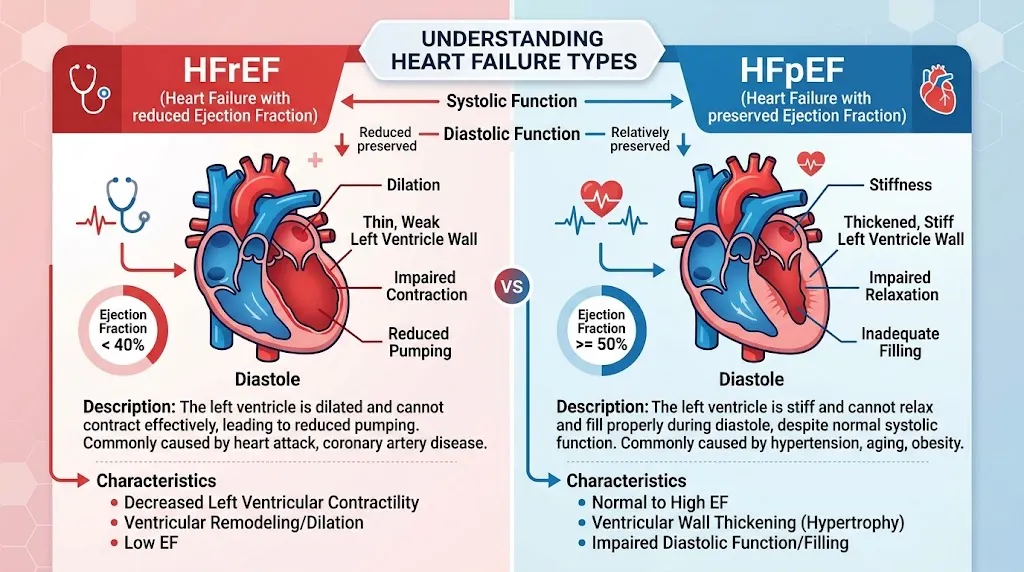
HFrEF, or heart failure with reduced ejection fraction, occurs when the heart’s pumping function is reduced. Current U.S. heart-failure definitions generally place HFrEF at an LVEF of 40% or less.
HFpEF, or heart failure with preserved ejection fraction, occurs when a person has heart failure despite an LVEF of 50% or higher. The heart may contract with a normal-looking percentage, but the ventricle can have difficulty relaxing and filling properly, and filling pressures may be elevated.
You may also see HFREF and HFPEF in older medical articles. These terms refer to reduced and preserved ejection fraction, respectively. Modern clinical writing more commonly uses HFrEF and HFpEF.
HFrEF vs HFpEF: Key Differences
The biggest distinction is the ejection fraction, but the differences go beyond a single number.
With HFrEF, the left ventricle does not contract effectively enough to eject a normal proportion of its blood. This is often associated with damage or weakening of the heart muscle.
With HFpEF, the ejection fraction remains preserved, but the heart can become stiff or less able to relax. As a result, the ventricle may not fill normally, and pressure can build up in the heart and lungs.
| Feature | HFrEF | HFpEF |
| Full name | Heart failure with reduced ejection fraction | Heart failure with preserved ejection fraction |
| Typical LVEF | ≤40% | ≥50% |
| Main functional problem | Reduced contraction | Impaired relaxation/filling and elevated filling pressures |
| Common associated conditions | Coronary disease, previous heart attack, cardiomyopathy | Hypertension, heavier people, diabetes, atrial fibrillation |
| Symptoms | Breathlessness, fatigue, swelling, reduced exercise tolerance | Breathlessness, fatigue, swelling, reduced exercise tolerance |
| Diagnosis | EF plus clinical evidence of HF | EF plus clinical evidence and evidence of increased filling pressures |
| Treatment approach | Multiple evidence-based HF medications | Comorbidity management plus therapies supported for HFpEF |
The middle range, 41% to 49%, is generally classified as HFmrEF, or heart failure with mildly reduced ejection fraction.
What Causes HFrEF and HFpEF?
HFrEF can develop when the heart muscle has been damaged or weakened. Common contributors include coronary artery disease, previous myocardial infarction, cardiomyopathy, certain valve disorders, and other conditions that impair the heart’s pumping ability.
HFpEF has a different pattern of risk factors. High blood pressure is an important risk factor, and HFpEF is also commonly associated with heavier people, type 2 diabetes, atrial fibrillation, chronic kidney disease, and other cardiovascular or metabolic conditions.
Research has also shown that HFrEF and HFpEF can have overlapping causes. Therefore, the distinction should not be reduced to a simple list of “causes.”
What Symptoms Do HFrEF and HFpEF Cause?
HFrEF and HFpEF can produce many of the same symptoms.
Common symptoms include:
- Shortness of breath, particularly with activity
- Fatigue or weakness
- Reduced ability to exercise
- Swelling in the legs, ankles, or feet
- Difficulty breathing when lying down
- Rapid weight gain from fluid retention
- A feeling of fullness or congestion
Because the symptoms overlap, symptoms alone cannot reliably tell someone whether they have HFrEF or HFpEF.
A medical evaluation is needed to determine the cause and type of heart failure.
How Are HFrEF and HFpEF Diagnosed?
An echocardiogram is commonly used to measure LVEF and evaluate heart structure and function. The American Heart Association identifies echocardiography as the most widely used test for measuring EF.
For HFrEF, a reduced EF can provide an important part of the diagnosis when combined with appropriate clinical evidence of heart failure.
HFpEF can be more challenging to diagnose because the EF may appear normal. Current guidance emphasizes evidence of increased left-ventricular filling pressures, which may come from natriuretic peptides, imaging, or other hemodynamic testing.
Doctors may also use blood tests such as BNP or NT-proBNP, an ECG, chest imaging, stress testing, or other investigations depending on the patient’s symptoms and medical history.
Importantly, a normal natriuretic peptide level does not always rule out HFpEF. The 2026 ACC pathway notes that natriuretic peptide concentrations can be lower in some people with HFpEF, including people with heavier people.
How Is HFrEF Treated?
HFrEF has several well-established medication classes that can reduce complications and improve outcomes in appropriate patients.
The 2022 AHA/ACC/HFSA guideline identifies four major medication groups for HFrEF:
- ARNI, ACE inhibitors, or ARBs
- Evidence-based beta blockers
- Mineralocorticoid receptor antagonists (MRAs)
- SGLT2 inhibitors
These therapies are selected according to the patient’s condition, kidney function, blood pressure, potassium level, other medications, and potential contraindications.
Diuretics may also be used when fluid overload causes congestion. Other treatments can address underlying coronary disease, abnormal heart rhythms, valve disease, or other contributors.
Treatment should be individualized by a qualified healthcare professional rather than based solely on an EF number.
How Is HFpEF Treated?
HFpEF treatment has changed significantly as research has developed.
The 2026 ACC Expert Consensus Decision Pathway describes SGLT2 inhibitors as a cornerstone therapy for HFpEF, based on randomized trials showing reductions in the combined risk of heart-failure hospitalization and cardiovascular death, along with improvements in health status.
Treatment also focuses heavily on conditions that contribute to HFpEF. These may include:
- High blood pressure
- Type 2 diabetes
- heavier people
- Atrial fibrillation
- Coronary artery disease
- Chronic kidney disease
- Sleep apnea
Depending on the individual, clinicians may consider SGLT2 inhibitors, mineralocorticoid receptor antagonists, ARNI or ARB therapy, and other treatments. The 2026 ACC guidance also discusses incretin-based therapies for selected people with HFpEF and heavier people.
Exercise and other non-drug strategies can also be part of care. The ACC pathway reports that several exercise-training studies in HFpEF have shown improvements in exercise capacity and quality of life.
What Is HFmrEF?
HFmrEF stands for heart failure with mildly reduced ejection fraction. It generally refers to heart failure with an LVEF between 41% and 49%.
This category sits between HFrEF and HFpEF. It is useful because patients in this EF range may not fit neatly into either traditional category.
Treatment recommendations can overlap with both groups, and SGLT2 inhibitors have an important role in HFmrEF under current guidelines.
FAQs:
Is HFrEF the same as systolic heart failure?
HFrEF is often called systolic heart failure because reduced contraction is an important feature. However, modern heart-failure classification relies on LVEF and the broader clinical syndrome rather than treating “systolic” and “diastolic” labels as complete descriptions.
Can you have heart failure with a normal ejection fraction?
Yes. HFpEF is an example of heart failure that can occur with a preserved EF. A person may have an EF in the normal or preserved range while having impaired ventricular relaxation, elevated filling pressures, and other evidence of heart failure.
Which EF range is considered preserved?
For heart-failure classification, HFpEF generally refers to an LVEF of 50% or higher, together with clinical evidence of heart failure and evidence supporting increased filling pressures.
Are HFrEF and HFpEF treated the same way?
No. There is some overlap, but treatment strategies differ. HFrEF has four major evidence-based medication classes forming the foundation of guideline-directed therapy, while HFpEF management places substantial emphasis on SGLT2 inhibitors and controlling associated conditions such as hypertension, diabetes, heavier people , and atrial fibrillation.
Conclusion:
The key to understanding HFrEF vs HFpEF is that ejection fraction is only one part of the picture. HFrEF generally involves an LVEF of 40% or less, while HFpEF involves an LVEF of 50% or more along with clinical evidence of heart failure.
Both conditions can cause similar symptoms, but their underlying mechanisms, associated conditions, diagnostic considerations, and treatment strategies can differ.
If someone has symptoms or an abnormal EF measurement, a healthcare professional can determine the appropriate diagnosis and treatment plan.