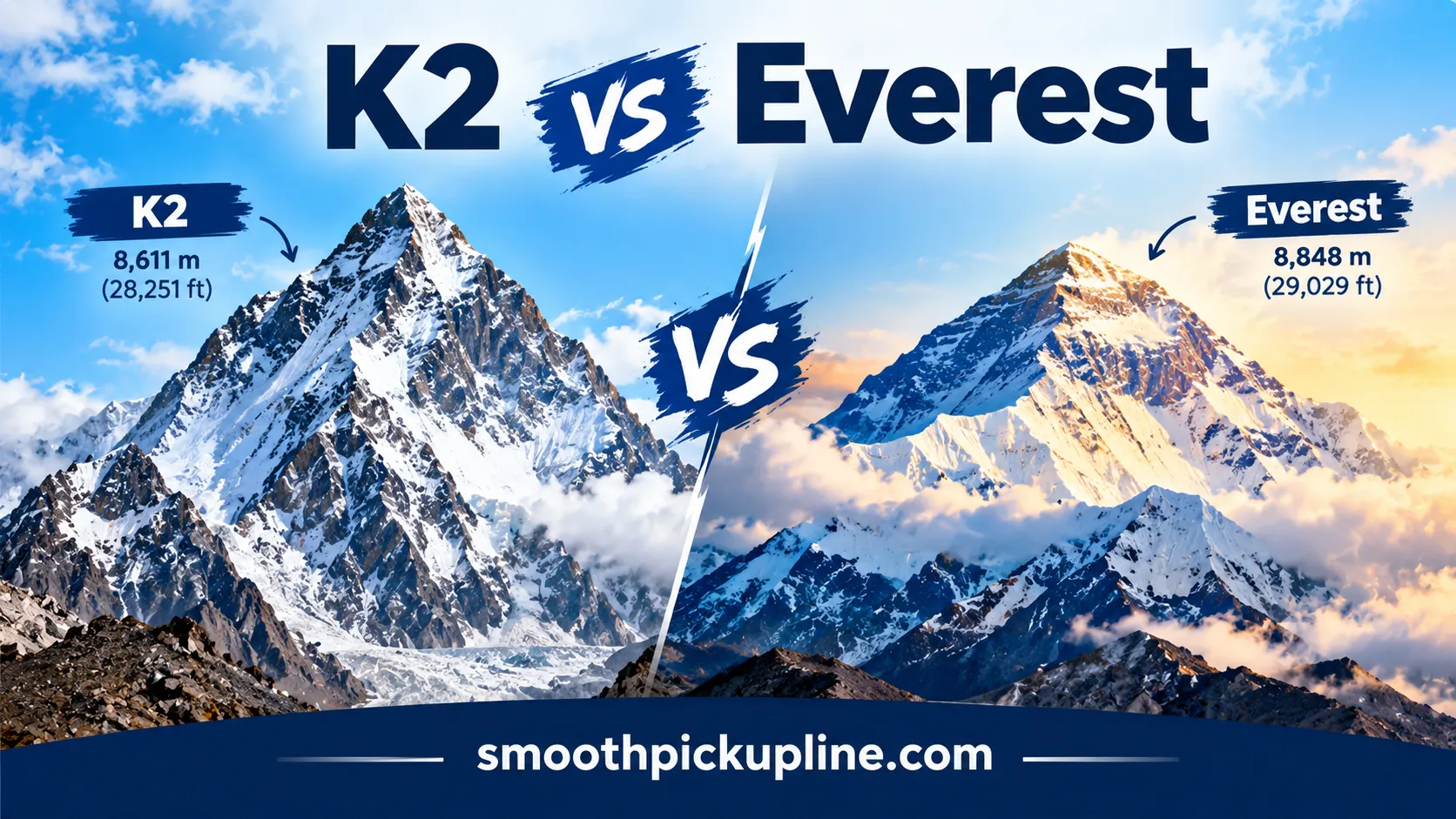
K2 and Mount Everest are both 8,000-meter peaks, but they present very different climbing challenges.
Everest is higher at 8,848.86 meters (29,031.7 feet), while K2 rises to 8,611 meters (28,251 feet).
K2 is generally regarded as more technically demanding because of its sustained steep terrain, exposed climbing, difficult weather, and limited margin for error.
Key Takeaways
- Everest is the world’s highest mountain; K2 is the second-highest.
- Everest is about 238 meters (781 feet) higher than K2.
- K2 is generally considered more technically difficult to climb.
- Everest’s most common routes have extensive expedition infrastructure and fixed-line systems.
- K2 has steep, sustained terrain and serious objective hazards, including rockfall, avalanches, and serac exposure.
- Historical fatality statistics need careful interpretation because deaths and successful summits are not the same as individual risk.
K2 vs Everest: Quick Comparison
| Feature | K2 | Everest |
| Height | 8,611 m (28,251 ft) | 8,848.86 m (29,031.7 ft) |
| Global height rank | 2nd | 1st |
| Mountain range | Karakoram | Himalayas |
| Location | Pakistan–China border | Nepal–China border |
| General technical difficulty | Extremely high | Extremely high, but common routes are less technical |
| Famous route | Abruzzi Spur | Southeast Ridge / South Col |
| Major hazards | Steep climbing, rockfall, avalanches, seracs, weather | Khumbu Icefall, altitude, avalanches, extreme weather |
| Typical reputation | Highly technical and demanding | Higher, more established, and heavily supported |
The comparison is easiest to understand when height and difficulty are treated as separate questions. Everest wins on elevation, but that does not automatically make it the more technically difficult mountain.
National Geographic describes K2’s main route as steeper and more sustained than Everest’s South Col route, requiring stronger proficiency on steep snow, ice, and rock.
Which Mountain Is Higher?
Everest is higher than K2 by approximately 238 meters, or about 781 feet.
Everest’s modern official elevation is 8,848.86 meters. The measurement was confirmed through the joint Nepal-China height project announced in 2020.
K2 stands at 8,611 meters, making it the second-highest mountain on Earth.
That difference may sound relatively small when both mountains rise more than eight kilometers above sea level. However, elevation is only one part of mountaineering difficulty.
At these heights, the atmosphere contains much less available oxygen than at sea level, and climbers face extreme cold, wind, fatigue, and altitude-related hazards.
So if the question is simply “Which is higher?”, the answer is clear: Everest.
Is K2 Harder Than Everest?
For technical climbing, K2 is widely regarded as the harder mountain.
That does not mean Everest is easy. Everest remains an extreme high-altitude expedition with serious hazards. Instead, the difference comes largely from the character of the routes.
Everest’s most commonly climbed routes have extensive infrastructure developed over decades. Fixed ropes, established camps, experienced guides, coach support, and commercial expedition systems have made the standard routes more accessible to experienced high-altitude climbers.
K2 offers considerably less margin for error.
National Geographic notes that K2 is much steeper and more sustained from a technical standpoint. Climbers may need to negotiate steep snow, ice, and rock while attached to fixed lines and using crampons and ascenders.
Technical Climbing
K2’s famous Abruzzi Spur contains sections that demand genuine rock and ice climbing skills.
One example is the Black Pyramid, a steep and technically challenging section encountered high on the mountain. National Geographic has described the terrain as requiring precise climbing at extreme altitude.
Everest certainly includes technical sections, particularly around the Khumbu Icefall and other steep areas. However, the standard South Col route is generally considered less continuously technical than K2’s principal route.
Steepness and Exposure
Steep terrain changes the nature of a climb.
On K2, significant portions of the route remain steep and exposed. A mistake can have immediate consequences because there may be little relatively easy terrain available for recovery.
This is one reason experienced mountaineers often describe K2 as a more technical objective than Everest.
K2 vs Everest: Route Differences
The two mountains also differ geographically.
Everest sits in the Himalayas on the Nepal-China border. Climbers commonly approach the summit from either Nepal through the Southeast Ridge or from Tibet through the North Ridge. National Geographic notes that although many routes have been pioneered, most climbers use one of these two major approaches.
K2 sits in the Karakoram on the Pakistan-China border. Its most commonly discussed climbing route is the Abruzzi Spur, which approaches the mountain from the southeast.
The surrounding environment also contributes to the difference.
K2 is notably remote, and reaching its base camp involves a demanding approach through the Karakoram. National Geographic has highlighted the mountain’s remoteness as one factor contributing to its reputation among experienced mountaineers.
Weather and Mountain Conditions
Weather is a major factor on both mountains.
Everest’s climbing season is shaped by the annual weather pattern in the Himalayas. Climbers typically depend on a limited period of suitable conditions for summit attempts.
K2 has an especially difficult weather reputation. Its location farther north in the Karakoram contributes to colder and more unpredictable conditions, while strong winds can make an already technical mountain even more challenging.
The mountain’s shape also matters.
K2’s steep faces and exposed ridges provide less forgiving terrain when conditions deteriorate. Rockfall and avalanche hazards can affect climbers even when the overall expedition is carefully planned.
Why K2 Has a Different Climbing Reputation
K2’s reputation comes from a combination of factors rather than one single obstacle.
First, it is extremely steep. Second, many sections require technical climbing skills. Third, the weather can be severe and unpredictable. Finally, some hazards occur in places where avoiding exposure is difficult.
The Bottleneck, located high on K2, is one of the mountain’s best-known hazards. It lies beneath large hanging seracs, creating a particularly serious section of the route. A major 2008 accident there resulted in 11 climbers dying.
This history has contributed strongly to K2’s reputation, although individual accidents should not be used to claim that every ascent follows the same pattern.
K2 vs Everest: Deaths and Risk
Fatality statistics are often used when people search for “K2 vs Everest,” but these numbers need context.
K2 has historically recorded a much higher ratio of deaths relative to successful summit ascents than Everest in commonly cited mountaineering datasets. However, deaths divided by summits is not the same thing as an individual’s probability of dying on an expedition.
The denominator matters, as do changes in climbing practices, expedition support, weather, route conditions, and the period being studied.
For Everest, the Himalayan Database maintains detailed expedition records covering routes, successes, deaths, accidents, oxygen use, and other information. Its current database incorporates records through the 2025 season.
Therefore, it is more accurate to say that K2 has historically had a harsher risk profile than Everest rather than reducing the comparison to one simple percentage.
Which Mountain Has More Successful Summits?
Everest has vastly more successful summit ascents.
There are several reasons. Everest has been climbed successfully for much longer, has more established infrastructure, attracts substantially more expeditions, and has developed a large commercial climbing industry.
K2 has seen far fewer successful ascents historically. National Geographic reported that more than 4,000 people had reached Everest by the late 2010s, while only hundreds had reached K2 at that time.
The difference in summit numbers therefore reflects not only mountain difficulty but also accessibility, expedition volume, infrastructure, history, and the number of people attempting each peak.
K2 vs Everest: Which One Is More Technical?
K2 is generally considered the more technically demanding of the two on their commonly climbed routes.
Everest’s major challenge is the combination of extreme altitude, long exposure, cold, weather, crevasses, icefall, and the physical demands of climbing above 8,000 meters.
K2 combines those high-altitude problems with more sustained steep climbing.
That distinction is important. Saying K2 is “harder” does not mean Everest is safe or simple. Both are extreme mountaineering objectives, and conditions can change dramatically from one expedition or season to another.
FAQs:
Is K2 harder than Everest?
K2 is generally considered harder from a technical climbing perspective. Its standard route has more sustained steep rock and ice terrain, while Everest’s most popular routes have extensive fixed-line infrastructure and expedition support. Everest remains an extremely demanding high-altitude mountain, so “easier” should not be confused with easy.
Is K2 higher than Everest?
No. Everest is higher. Its official elevation is 8,848.86 meters, while K2 is 8,611 meters. The difference is approximately 238 meters, or 781 feet.
Why is K2 considered harder?
K2 combines extreme altitude with sustained steep terrain, technical rock and ice climbing, severe weather, and serious objective hazards. Its remoteness and smaller expedition infrastructure also contribute to its reputation as a particularly demanding mountaineering objective.
Which mountain has more successful summits?
Everest has substantially more successful summit ascents than K2. Everest’s popularity, established routes, infrastructure, and larger number of expeditions have produced far more total summits over time. K2 has historically attracted fewer expeditions and has been significantly less frequently summited.
Can K2 and Everest be compared only by height?
No. Height is only one measure. Everest is higher, but technical difficulty depends on factors such as steepness, route character, weather, exposure, altitude, objective hazards, infrastructure, and the support available to climbers.
Conclusion:
The simplest way to understand K2 vs Everest is this: Everest is higher, while K2 is generally more technically demanding.
Everest reaches 8,848.86 meters, making it Earth’s highest mountain. K2 reaches 8,611 meters and ranks second in height.
Yet K2’s sustained steep terrain, technical climbing, severe weather, and limited margin for error give it a very different character.Both mountains represent extreme high-altitude mountaineering.
Comparing them is therefore less about finding a single “hardest” statistic and more about understanding how elevation, terrain, weather, infrastructure, and historical climbing conditions shape each mountain’s challenge.